A Tale of 1001 LoC: Potential Runtime Error-Guided Specification Synthesis for Verifying Large-Scale Programs
Abstract
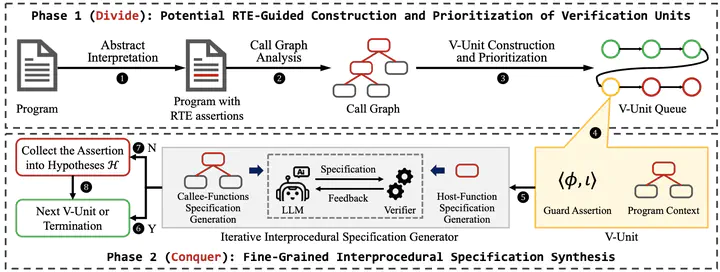
Fully automated verification of large-scale software and hardware systems is arguably the holy grail of formal methods. Large language models (LLMs) have recently demonstrated their potential for enhancing the degree of automation in formal verification by, e.g., generating formal specifications as essential to deductive verification, yet exhibit poor scalability due to context-length limitations and, more importantly, the difficulty of inferring complex, interprocedural specifications. This paper presents Preguss – a modular, fine-grained framework for automating the generation and refinement of formal specifications. Preguss synergizes between static analysis and deductive verification by steering two components in a divide-and-conquer fashion: (i) potential runtime error-guided construction and prioritization of verification units, and (ii) LLM-aided synthesis of interprocedural specifications at the unit level. We show that Preguss substantially outperforms state-of-the-art LLM-based approaches and, in particular, it enables highly automated RTE-freeness verification for real-world programs with over a thousand LoC, with a reduction of 80.6%$\sim$88.9% human verification effort.

Zhongyi Wang
Ph.D. Candidate
My research interests include formal verification and program analysis.


Mingshuai Chen
ZJU100 Young Professor
My research interests include formal verification, programming theory, and logical aspects of computer science.

Mingqi Yang
Ph.D. Candidate
My research interests include formal verification, programming theory, and mathematical aspects of computer science.